

Upgrading to a Media Filter Cabinet: Preventing HVAC Choke-Out During Thousand Oaks Ash Season
The Hidden Threat to Your HVAC System During Ash Season
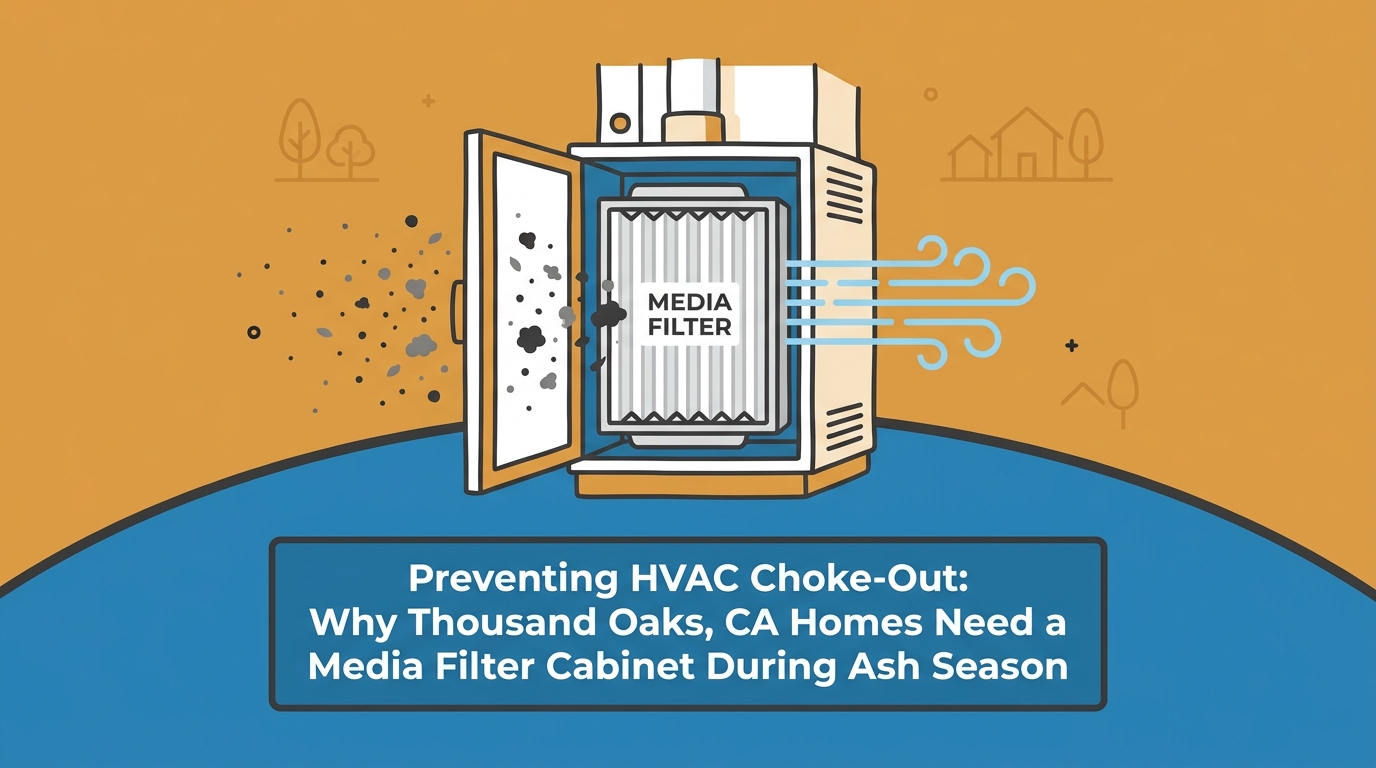
Your thermostat is set to 72 degrees, the blower is running nonstop, but the house still feels uncomfortably warm—and the faint smell of campfire smoke is lingering in the hallway. You check your air filter, expecting a little dust, only to find a solid, impenetrable wall of dark gray soot. For local homeowners, upgrading to a media filter cabinet: preventing HVAC choke-out during Thousand Oaks ash season is a critical mechanical priority. Every year, the late-summer/early-fall Santa Ana winds arrive, driving a sudden, heavy influx of fine particulates and wildfire ash directly toward residential neighborhoods. Homeowners naturally rush to the hardware store to buy the thickest, highest-rated filter they can find to protect their indoor air.
Here is the problem: inserting a dense, high-MERV 1-inch filter into a standard return rack to combat heavy ash actually starves your system of the air it needs to function. It is the equivalent of trying to run a marathon while breathing through a cocktail straw. The only permanent mechanical solution to maintain proper respiration while successfully capturing fine ash is installing a media filter cabinet. If you want to protect your HVAC system from catastrophic failure while simultaneously upgrading your indoor air quality solutions, you have to look beyond the filter aisle and address the physical ductwork of your home.
Why Standard 1-Inch Filters Choke Under Heavy Particulate Loads
To understand why standard filters fail so spectacularly during fire season, we have to examine the physics of airflow and static pressure. Static pressure is the resistance to airflow in your heating and cooling system's ductwork. Your blower motor is engineered to push and pull a very specific volume of air against a specific amount of resistance. Standard residential systems are typically only rated for the low initial resistance provided by basic MERV 7 or MERV 8 filters.
The MERV 13 Trap
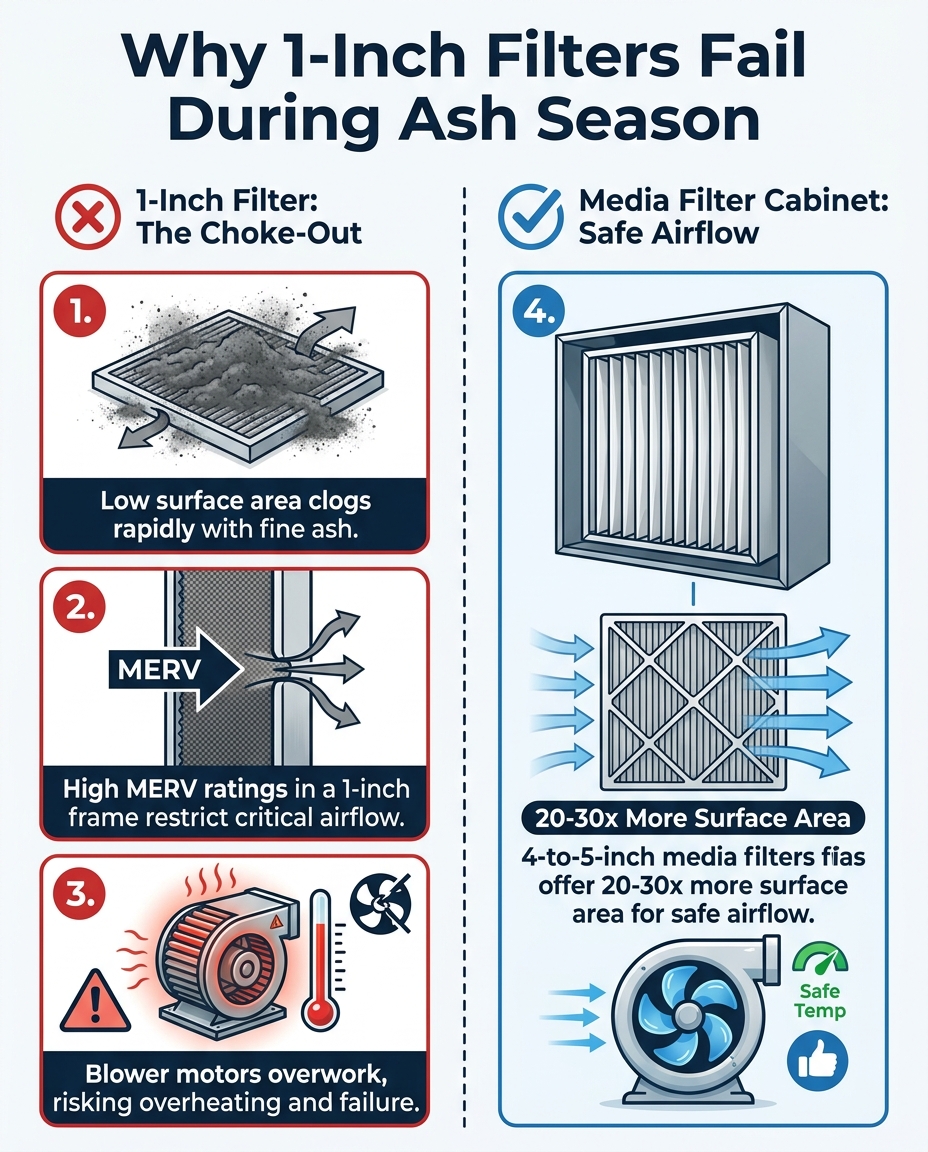
The EPA strongly recommends using a filter rated MERV 13 or higher to capture the microscopic PM2.5 particles found in wildfire smoke. However, cramming that level of dense filtration media into a standard 1-inch frame creates an immediate, restrictive wall. The tightly woven fibers required to trap smoke block the air right along with the ash.
When comparing 1-inch pleated vs 4-to-5-inch media filters, the primary point of failure is surface area. A standard 1-inch filter has a remarkably low surface area. When bombarded with heavy ash from the Santa Ana winds, that small surface area clogs entirely within a matter of days—sometimes hours. As the barrier becomes solid, your system struggles to pull air through it, causing an immediate, drastic drop in your air conditioning performance.
Comparing Filtration Capacities
• Surface Area — Standard 1-Inch Pleated Filter: Minimal (clogs rapidly under heavy load) — 4-to-5-Inch Media Filter Cabinet: 20 to 30 times more surface area
• Airflow Resistance — Standard 1-Inch Pleated Filter: Extremely high when rated MERV 13+ — 4-to-5-Inch Media Filter Cabinet: Low (maintains safe static pressure)
• Ash Season Lifespan — Standard 1-Inch Pleated Filter: 1 to 2 weeks maximum before choking — 4-to-5-Inch Media Filter Cabinet: Months of reliable, safe protection
• Structural Integration — Standard 1-Inch Pleated Filter: Slides loosely into an existing flimsy rack — 4-to-5-Inch Media Filter Cabinet: Custom sheet metal housing sealed tight

How Late-Summer Heat and Santa Ana Winds Create a Dual Threat
Living in Thousand Oaks CA means dealing with a highly specific environmental strain on your mechanical equipment. We do not just experience poor air quality; we experience it simultaneously with extreme heat. High cooling demand during late-summer heatwaves happens at the exact same time as high ash loads driven by the winds. This creates a perfect storm for mechanical failure.
The Reality of PM2.5 Spikes
Historical air quality data for our region shows massive spikes in particulate matter (PM2.5) during these specific wind events. The air is thick with microscopic debris. At the same time, the temperature outside is soaring past 95 degrees, meaning your thermostat is calling for the air conditioner to run continuously.
Running an air conditioner constantly to combat extreme heat while the filter is simultaneously being choked by heavy ash accelerates wear and tear exponentially. The system is trying to pull massive volumes of air to cool your home, but the clogged 1-inch filter acts like a brake on the entire process.
Why generic advice fails: You will often hear generic advice to "just change your filter more often" during a wildfire event. While swapping a dirty filter is necessary, it is insufficient for this specific regional climate combination. Even a brand-new 1-inch MERV 13 filter restricts too much air for a system trying to survive a Thousand Oaks heatwave. The equipment needs to breathe freely to cool the house, and a thin, dense filter simply will not allow it.
The Mechanical Advantage of a 4-to-5-Inch Media Filter Cabinet
The solution to the airflow crisis lies in geometry. The physical properties of media cabinets provide a massive mechanical advantage over standard filter racks. The difference between 1-inch pleated vs 4-to-5-inch media filters comes down to the deep, accordion-like pleats found in the larger units.
The Power of Surface Area
A 4-inch to 5-inch media filter contains 20 to 30 times the surface area of a standard 1-inch filter. If you were to take the filter material out of a media cabinet and stretch it completely flat, it would cover a massive amount of floor space. This expansive surface area is the secret to high-capacity filtration. It allows the filter to utilize high-MERV, hospital-grade material to capture microscopic ash and smoke particles without restricting critical airflow. The air has dozens of square feet of media to pass through, keeping static pressure low and the blower motor happy.
A Permanent Structural Solution
It is critical to understand that a media filter cabinet is not a temporary seasonal band-aid. It is a permanent structural ductwork modification. Upgrading your ducting and airflow at the filter rack fundamentally changes how the system respires. Instead of sliding a flimsy piece of cardboard into a loose slot in the drywall, a heavy-duty metal cabinet is fabricated directly into the return drop of your air handler or furnace. This ensures that 100% of the air is forced through the deep-pleated media, completely transforming your home's defense against fine particulates while protecting the machinery itself.
Preventing Blower Motor Burnout and Evaporator Coil Freezing
Ignoring the airflow restriction problem during ash season leads to severe, expensive mechanical consequences. When a system is choked by a clogged 1-inch filter in Thousand Oaks CA, two major failures typically follow: blower motor burnout and evaporator coil freezing.
The Strain on the Blower Motor
Modern HVAC systems often use ECM (Electronically Commutated Motors) for the blower. These "smart" motors are designed to ramp up their speed to overcome resistance and deliver the requested amount of air. When a filter clogs with ash, the ECM motor spins faster and works harder to pull air through the blockage. This restricted airflow forces the blower motor to overwork continuously, leading to severe overheating. Eventually, the thermal limits are breached, and the motor burns out completely—an expensive repair that could have been prevented with proper filtration.
The Physics of a Frozen Coil
The second major consequence is a frozen evaporator coil. Your air conditioner's indoor coil gets extremely cold as refrigerant expands inside it. It relies on a constant flow of warm, unconditioned air from your home blowing over it to absorb the heat and keep the coil from dropping below freezing.
• The restriction: The clogged filter stops the warm air from reaching the coil.
• The temperature drop: Without heat to absorb, the refrigerant drops the coil's surface temperature below 32 degrees.
• The freeze: Condensation on the coil instantly turns to ice.
• The block: The ice block further restricts airflow, compounding the problem until the system shuts down completely.
A typical pattern we see involves homeowners enduring years of continual repairs and high energy bills because their system is suffocating. In one fall service call, our team found a system severely restricted by improper filtration. By making structural improvements to the units and upgrading the filtration housing to a proper media cabinet, the system's efficiency increased drastically. Addressing the root cause of airflow restriction permanently improves system efficiency and prevents cascading mechanical failures. Those units now run perfectly, saving the homeowner significantly on energy bills while finally delivering consistent comfort.
Modifying Your Ductwork for High-Capacity Filtration
Because a media cabinet fundamentally changes the respiration of the HVAC system, this is a professional mechanical upgrade, not a weekend DIY project. Installing the housing requires specialized tools, sheet metal fabrication skills, and a deep understanding of airflow dynamics.
Custom Sheet Metal Fabrication
Installing a media cabinet requires custom sheet metal modification to the existing return drop or air handler. The old, restrictive 1-inch filter slot must be removed or bypassed. The new cabinet is then measured, cut, and integrated directly into the ductwork.
The airtight seal: Emphasizing the importance of an airtight seal cannot be overstated. If the new cabinet is not perfectly sealed with mastic and foil tape, the heavy static pressure of the blower will pull dirty, ash-filled air through the tiny gaps in the metal, completely bypassing the filter. This defeats the entire purpose of the upgrade and allows soot to coat the sensitive blower wheel and evaporator coil.
Calibrating Static Pressure
Once the sheet metal work is complete, a professional technician must calibrate the static pressure of the system. Testing the external static pressure (ESP) ensures the blower is operating within the manufacturer's strict specifications with the new 4-to-5-inch media filter in place.
We frequently see homeowners who just need clear filtration system information during a general service visit. During a recent spring appointment, our technicians took the time to provide thorough, easy-to-understand explanations about how different filtration systems impact static pressure. That customer received valuable insights and felt well-informed about the exact structural modifications required to protect their equipment from the 1-inch pleated vs 4-to-5-inch media filters dilemma.
Maintaining Optimal Indoor Air Quality Year-Round
While the immediate threat of late-summer/early-fall Santa Ana winds often drives the decision to upgrade, a media filter cabinet provides massive benefits long after fire season ends. Transitioning from an urgent seasonal response to long-term maintenance reveals the true value of the investment.
Lifespan and Everyday Protection
A high-capacity media filter typically lasts 6 to 12 months under normal, everyday conditions. However, heavy ash seasons may require a post-season swap to clear out the massive volume of soot captured during the wind events. Outside of fire season, the cabinet continues to protect the home constantly. Its deep pleats trap everyday dust, volatile organic compounds, heavy pet dander, and spring pollen with incredible efficiency.
Upgrading the filtration housing is a core component of comprehensive indoor air quality solutions. It serves as the foundation upon which all other IAQ products—like UV lights and air scrubbers—rely.
Pairing Filtration with Maintenance
To get the absolute most out of your new media cabinet, it is vital to pair high-capacity filtration with routine HVAC maintenance. A clean filter protects the equipment, but routine tune-ups ensure the motors, capacitors, and refrigerant levels are optimized for peak longevity. Together, they create a mechanical environment that runs cleaner, quieter, and far more efficiently year-round.
Protect Your Home's Airflow Before the Next Wind Event
A high-capacity media filter cabinet is the only mechanical way to get hospital-grade filtration without destroying your system's critical airflow. Do not wait until your 1-inch filter clogs and your coils freeze solid during the next major heatwave. Schedule an inspection of your current filter rack and ductwork today. Consult with our local Thousand Oaks CA experts to safeguard your HVAC system, maintain perfect airflow, and permanently solve the airflow restriction problem while capturing fine ash.
Frequently Asked Questions
Can wildfire smoke damage my AC?
Yes, wildfire smoke and ash can severely damage your AC system if it bypasses the filter or clogs it entirely. The fine particulates coat the evaporator coil and blower wheel, reducing efficiency and causing the system to overheat. Prolonged exposure without proper filtration often leads to expensive motor failures and frozen coils.
Why does a high MERV filter restrict airflow?
A high MERV filter restricts airflow because the fibers are woven incredibly tight to trap microscopic particles. When you compress that dense material into a standard 1-inch frame, the surface area is too small for the air to pass through easily. The resulting resistance creates high static pressure, choking the blower motor.
How to filter wildfire ash without damaging HVAC?
The safest way to filter wildfire ash without damaging your HVAC system is to install a 4-to-5-inch media filter cabinet. This ductwork modification provides 20 to 30 times more surface area than a standard filter. It allows you to use a dense, high-MERV material to trap the ash while maintaining the wide-open airflow your motor needs.
What MERV rating is best for wildfire smoke?
The EPA recommends a filter rated MERV 13 or higher to effectively capture the fine PM2.5 particles found in wildfire smoke. However, you should only use a MERV 13 rating if your system has been upgraded to a deep-pleated media cabinet. Using a MERV 13 filter in a standard 1-inch slot will rapidly restrict airflow and damage the equipment.
How often should I change my HVAC filter during fire season?
If you are using a standard 1-inch filter during an active fire season, you may need to change it every one to two weeks, as it will clog with ash rapidly. If you have upgraded to a 4-inch or 5-inch media cabinet, the filter can often handle the entire heavy ash season, though a post-season swap is highly recommended to start fresh.
Can I install a media filter cabinet myself?
No, installing a media filter cabinet is not a DIY project. It requires custom sheet metal fabrication to modify your existing return drop and ensure an absolutely airtight seal. Furthermore, a professional must test and calibrate the system's static pressure after installation to ensure the blower motor is operating safely.

Service Areas
Our service areas encompass a wide range of locations, ensuring that we can meet the needs of our clients wherever they are. From bustling urban centers to serene suburban neighborhoods, we are committed to providing top-notch services tailored to each community.